Monday, June 30, 2014

Friday, June 27, 2014
Will the Alice Corp decision breathe new life into the Jepson claim format?
 |
| Meet George Jepson! |
Like most patent attorneys, I've avoided using the "Jepson" claim format, in an effort to avoid conceding that anything is prior art. It's the way I was trained.
However, I'm reconsidering my reluctance in light of the Supreme Court's recent decision in Alice Corp, and the USPTO's preliminary guidelines, which were issued last Wednesday (see post below).
Here's the important bit: once an examiner decides that a claim includes an abstract idea, they are to determine "whether any element, or combination of elements, in the claim is sufficient to ensure that the claim amounts to significantly more than the abstract idea itself."
Limitations referenced in Alice Corp. that may be enough to qualify as "significantly more" when recited in a claim with an abstract idea include, as non-limiting or non-exclusive examples:
- Improvements to another technology or technical field;
- Improvements to the functioning of the computer itself;
- Meaningful limitations beyond generally linking the use of an abstract idea to a particular technological environment.
Right?
Thursday, June 26, 2014
It's not illegal. It's just expensive.

So let's be clear: the Supreme Court didn't say that Aereo's business is illegal. It said that Aereo is violating copyrights. If they want to pay licensing fees (like cable operators do) they can keep right on going. The problem is that their business model is probably not financially sustainable if they do that - their subscribers are undoubtedly mostly former cable/FIOS/satellite subscribers who ditched their previous provider(s) because of their high fees and crappy customer service. Those folks don't pay Aereo enough money now to defray the licensing fees that Aereo would have to pay to stay in business, and if Aereo did pay the licensing fees and pass that cost through to subscribers, their subscribers will lose their main motivation for ditching their traditional content providers.
But it's not illegal.
Wednesday, June 25, 2014
I find myself in a disturbing position

Today, the Supreme Court handed down its decision in ABC v Aereo, finding that the TV-antenna-rental service provided by Aereo is a copyright violation.
The majority decision was written by Bryer; Scalia authored a dissent, joined by Thomas (shocking!) and Alito. And I find myself in the somewhat uncomfortable position of agreeing with Scalia. Check this bit from the dissent:
I share the Court's evident feeling that what Aereo is doing (or enabling to be done) to the Network's copyrighted programming ought not to be allowed. But perhaps we need not distort the Copyright Act to forbid it. As discussed at the outset, Aereo's secondary liability for performance infringement is yet to be determined, as is its primary and secondary liability for reproduction infringement. If that does not suffice, then (assuming one shares the majority's estimation of right and wrong) what we have before us must be considered a "loophole" in the law. It is not the role of this Court to identify and plug loopholes. It is the role of good lawyers to identify and exploit them, and the role of Congress to eliminate them if it wishes. Congress can do that, I may add, in a much more targeted, better informed, and less disruptive fashion than the crude "looks-like-cable-TV" solution the Court invents today.
Well, OK, that last bit about Congress being able to do something is crazy talk, but still...
Tuesday, June 24, 2014
Which way, Alice?
 |
| We're all mad here. |
Seems reasonable to me. I guess we'll find out soon enough. For what it's worth, there's a Software Partnership Meeting coming up next month at the USPTO - so they've got a month to figure out what they're going to do with this problem, at which point they'll tell us (I hope). In the meantime, the Supreme Court is acting like the Cheshire cat, giving us unhelpful directions and then fading away.Hence there are strong grounds for the proposition that a patent claim reaches a safe harbor from Section 101 abstract idea scrutiny, including the Mayo second question for an “inventive concept,” if the claimant establishes that the claim is directed to a solution of a technological problem. This definition of abstract idea as excluding applied technology accommodates the case law treating pure mathematical statements, economics and finance, and schemes of a non-technical character (“methods of organizing human activity”) as “abstract ideas” that must be include additional elements to achieve patent eligibility (Mayo step two).

UPDATE
The USPTO has issued preliminary guidelines for examiners to follow in light of the Alice Corp. decision. My first thought: that was fast. More thoughts to follow.
Monday, June 23, 2014
"Redskins" disparaging? How about "Amish Mafia?"
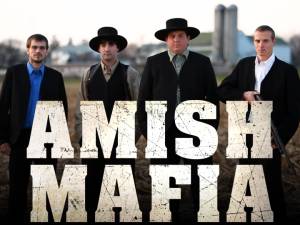
Discovery argues, in part, that even if the mark is disparaging, it's not disparaging to all Amish, but only to the Amish who are also involved in organized crime. And they may have a point, noting the following marks that have NOT been denied registration:
MAFIA GRANNIES (Reg. No. 4250545)
PORTUGUESE MAFIA (Reg. No. 4404311)
DUTCH MAFIA (Reg. No. 4391891, 4391890, 4391887)
AMERICAN MAFIA (Reg. No. 4208994)
THE MEXICAN MAFIA (Reg. No. 3665101)
THE LESBIAN MAFIA (Reg. No. 3361741)
Technical note - commenting

I have rectified that situation - comments are now open, without registration. I will be moderating comments, however, so don't be a d**k.
Subscribe to:
Posts (Atom)